
Buddhism in China
Discover Buddhism's various schools and their spread across this part of the world.
 Évariste Huc
 China, an introduction
 Hebei
 Inner Mongolia
 Ningxia
 Gansu
 Qinghai
 Tibet
 Buddhism
 Behind the scenes
 The Quest for the Celestial Dragon
Thematic canvas
From the exhibition panel
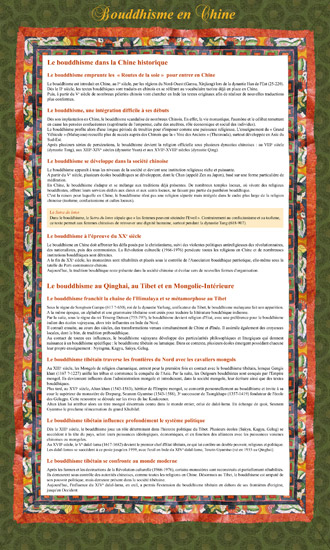
The text below is excerpted from the thematic canvas shown alongside it.
Buddhism in historical China — Buddhism enters China via the Silk Roads.
Buddhism arrives in China in the 1st century through the northwestern regions (Gansu, Xinjiang) during the Eastern Han dynasty (25-220). By the 2nd century, Buddhist texts are being translated into Chinese, drawing on the Taoist vocabulary already established there. From the 5th century, many Chinese pilgrims travel to India to seek out original texts for new, more faithful translations.
A difficult integration at first: monastic life, almsgiving and celibacy challenge Confucian thinking (the supremacy of the emperor, ancestor worship). Buddhism takes advantage of a long period of turmoil to establish itself as a religious power, with the teaching of the "Great Vehicle" (Mahayana) finding more success among the Chinese than the "Way of the Elders" (Theravada).
In Lhasa, the Potala Palace was the seat of Tibetan theocratic power from the late 17th century until the 20th century. This fortress-palace, 400 m wide and 118 m tall, spans thirteen levels; a thousand rooms form an intricate maze of halls, chambers and galleries. Today, about fifty rooms are open to visitors.
"Lamas are expected to study their whole lives, for religious knowledge is held to be inexhaustible. Students are divided among four Faculties: mysticism, liturgy, medicine, and prayer — the latter being the most esteemed and the best rewarded."
— Évariste Huc — Recollections of a Journey through Tartary and Tibet
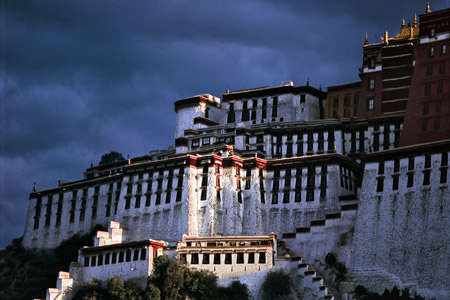
The Potala
A fortress-palace 400 m wide and 118 m tall, spanning thirteen levels, where a thousand rooms form a maze of halls, chambers and galleries.
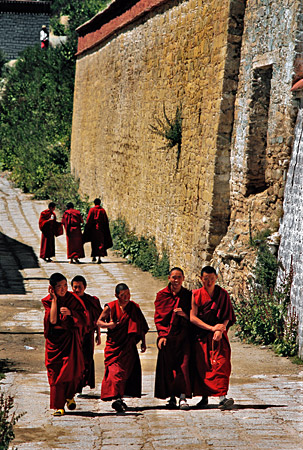
Monks at Ganden monastery
Lamas are divided among four Faculties — mysticism, liturgy, medicine and prayer — the latter being the most esteemed and the best rewarded.
"Lamas are expected to study their whole lives, for religious knowledge is held to be inexhaustible. Students are divided into four sections, or four Faculties, according to the special studies they wish to pursue."
— Évariste Huc — Recollections of a Journey through Tartary and Tibet
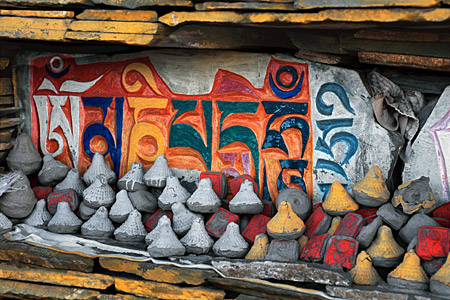
A tsa-tsa before a mani stone painted with the mantra "Om mani padme hum"
The tsa-tsa (in Tibetan) is a small clay icon representing a deity or religious symbol, made from clay mixed with the ashes of an important lama.
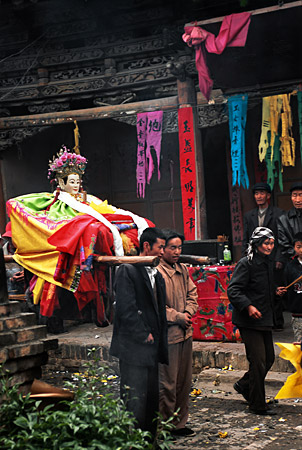
A religious procession in a Chinese Buddhist temple, Xining valley
For most Buddhists, the historical Buddha remains the most eminent figure of a vast, cosmopolitan pantheon, and the object of significant devotion.
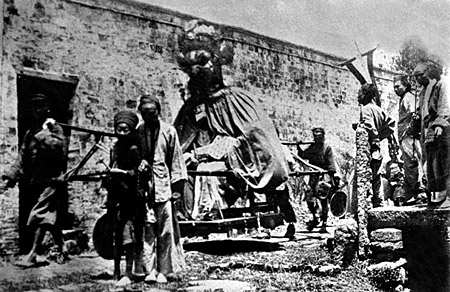
Photograph from the early 20th century (Congregation of the Lazarist Mission of Paris)
By the middle of the century, the Han emperors officially embraced Indian Buddhism in China, which the Chinese called the religion of Fô.
"Around the middle of our era, the emperors of the Han dynasty officially embraced, in China, Indian Buddhism. This religion, with its material representations of the Divinity, spread rapidly among the Chinese, who called it the religion of Fô."
— Évariste Huc — The Chinese Empire
And 18 more photographs with captioned panels…