
Gansu Province
Discover the evolution of this region through history.
 Évariste Huc
 China, an introduction
 Hebei
 Inner Mongolia
 Ningxia
 Gansu
 Qinghai
 Tibet
 Buddhism
 Behind the scenes
 The Quest for the Celestial Dragon
Fact sheet
- Name
- Gansu Province, Gansu Sheng in Chinese
- Area
- 454,000 km²
- Capital
- Lanzhou — 3,100,000 inhabitants (2004), 1,500 m elevation
- Population
- 25,000,000 inhabitants (2004), 57/km²
- Main ethnic groups
- Han (92%), Uyghur, Zhuang, Hui, Tibetan, Mongol, Kazakh, Tu, Salar, Dongxiang
- Climate
- Cold, dry continental — from -12°C in winter to +29°C in summer in Lanzhou
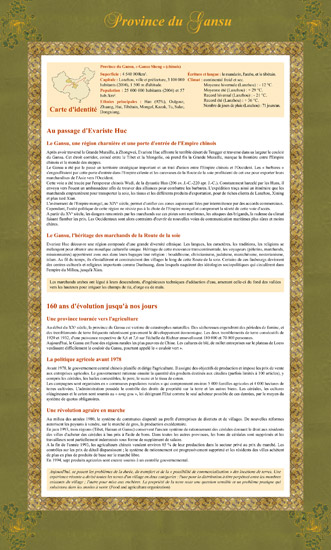
Thematic canvas
From the exhibition panel
The text below is excerpted from the thematic canvas shown alongside it.
In Évariste Huc's footsteps — Gansu, a hinge region and gateway to the Chinese Empire.
After crossing the Great Wall at Zhongwei, Évariste Huc braves the fearsome Tengger Desert and crosses the width of the Gansu corridor. This narrow passage, where the Great Wall comes to an end, is wedged between Tibet and Mongolia, marking the border between the Chinese Empire and the world of the steppes.
Gansu was historically an important strategic territory and a link between the Chinese Empire and the West. "Barbarians" poured through this gateway into the Celestial Empire, while Silk Road caravans used the route to export goods from Asia to the West.
"The ability to travel freely and without hindrance through all the provinces is, in a sense, indispensable to these populations, ceaselessly engaged in large- and small-scale trade."
— Évariste Huc — The Chinese Empire
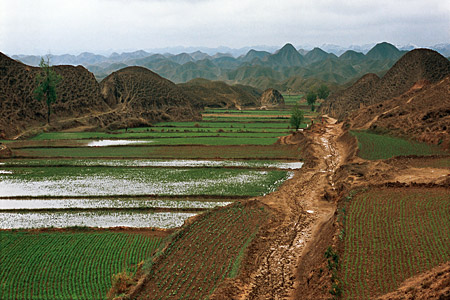
Wheat and millet fields in the green Gansu corridor
China has been the world's largest wheat producer since the early 1980s, its output rising from 14.3 to 116 million tonnes between 1961 and 2007.
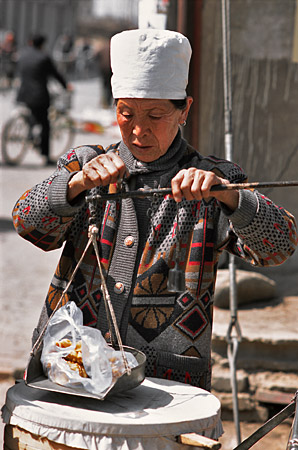
Hui merchant woman in the town of Yongdeng
The ability to travel freely across every province was, in a sense, indispensable to these populations, ceaselessly engaged in large- and small-scale trade.
"The ability to travel freely and without hindrance through all the provinces is, in a sense, indispensable to these populations, ceaselessly engaged in large- and small-scale trade."
— Évariste Huc — The Chinese Empire
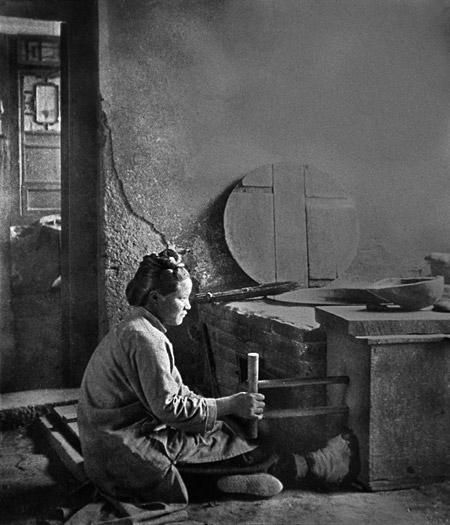
Photograph from the early 20th century (Paris Foreign Missions)
Every subject of the Celestial Empire has a remarkable gift for cooking; a single iron pot is enough for them to pull off the most difficult combinations.
"All the inhabitants of the Celestial Empire, without exception, have a remarkable aptitude for culinary preparations... What is most astonishing is the excessive simplicity of their means; a single iron pot is enough for them to promptly carry out the most difficult combinations."
— Évariste Huc — The Chinese Empire
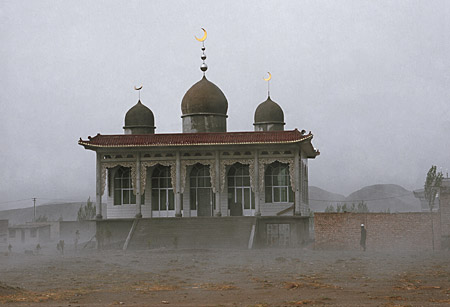
A mosque in the mist, near Yongdeng
The Hui community's "religious community" system (jiaofang) combined religion and economy: a mosque had to be built wherever their community settled.
And 5 more photographs with captioned panels…